

The Machine That Shouldn't Exist
On The Antikythera Mechanism

“Time, which antiquates antiquities, and hath an art to make dust of all things, hath yet spared these minor monuments.”
— Thomas Browne, Urn Burial
Welcome to this week’s This Week We Learnt!
This week, I have for you one of my favourite ancient discoveries and one of the most remarkable objects to survive from the ancient world: the Antikythera Mechanism, an ancient Greek astronomical calculator dating to c. 100 BC, often called the world’s first computer.
While its technological complexities are somewhat beyond me, I hope to give you a brief introduction into this incredible device!
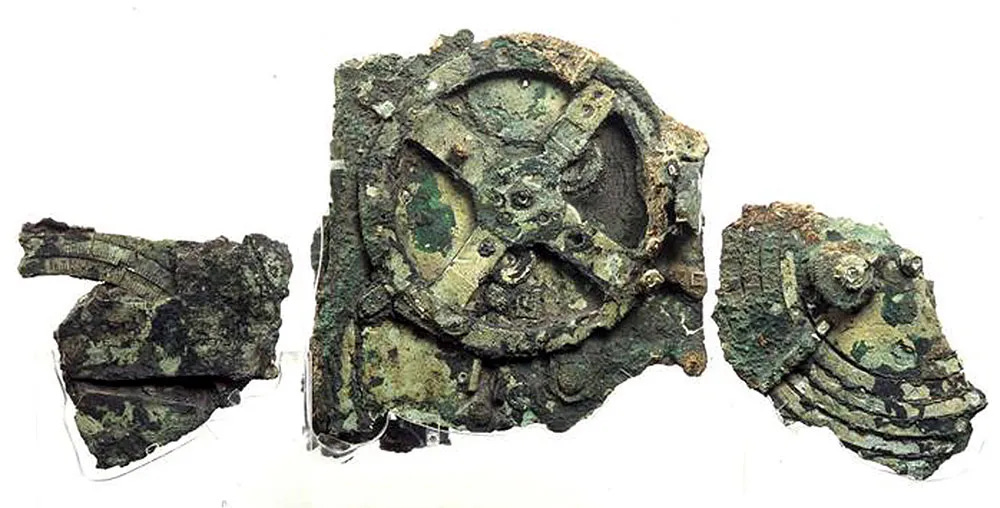
The Antikythera Mechanism was recovered in 1901 from the wreck of a 1st century BCE trading ship that sank near the island of Antikythera in the Mediterranean Sea. It was, by all appearances, a corroded lump of metal of little distinction, surfaced by divers among a range of amphorae and bronze statues.
For decades after its recovery, the device remained largely unexamined, assumed to be some form of navigational instrument, and attracted little sustained scholarly attention. It was not until the 1970s, when physicist Derek de Solla Price more clearly established the intricacies of the device’s inner workings, that interest was sparked in earnest.

Since then, the Antikythera Mechanism has proved a great challenge to researchers and the wider scholarly tradition alike, as they attempt both to understand its great technological complexities and reconcile them with the generally accepted narrative of ancient scientific development: a narrative built largely upon a far richer tradition of textual sources.
How does it work?
The device, when recovered, was split into 82 fragments, with only a third of its original mechanism surviving. The parts that do survive are, however, remarkably informative for identifying its function.
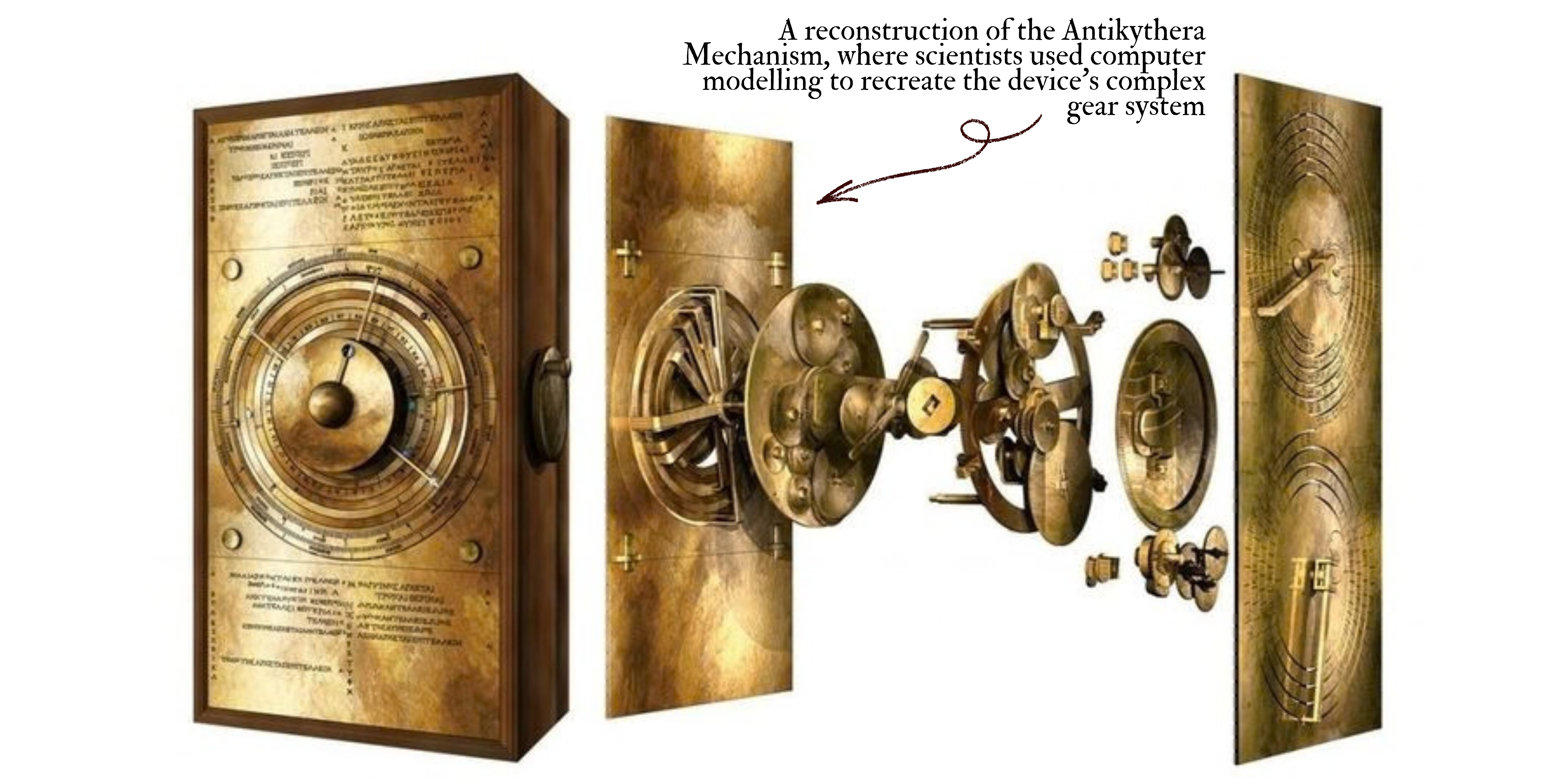
Thirty corroded bronze gears survive, which are known to have worked in concert to produce a revolution equivalent to one solar year. On the front of the mechanism is a large dial showing the position of the Sun and the Moon in the zodiac, with a a small ball, resembling a quarter moon, displaying lunar phases. The mechanism displaying the lunar phases is especially sophisticated: it employs a specialised combination of gears that replicate the moon's irregular motion across the sky, a variation Greek astronomers of the time had identified and termed the “first anomaly.”
In 2005, Microfocus X-ray CT decoded the structure of the rear of the machine, revealing it houses two large dials. The upper dial displays the Metonic cycle. It has a five-turn spiral slot with a moving pointer that displays the 235 full moon cycles from new moon to new moon occuring over 19 years. The span of 19 years is astronomically significant, as the sun and moon return to almost exactly the same position relative to each other; thus, tracking this cycle is invaluable for keeping lunar and solar calendars in alignment.
A subsidiary upper dial tracks a period of four-years, tracing when the various Panhellenic games would take place, four separate, prestigious athletic festivals in ancient Greece alternating between the Olympic, Pythian, Nemean, and Isthmian Games.

The lower dial tracks the Saros cycle, a period of 18.2-years after which eclipses recur in a predictable pattern. It has a four-turn spiral with symbols to mark months in which there was a high statistical likelihood of a solar or lunar eclipse. These astronomical cycles would have been known to the Greeks from Babylonian astronomical sources, a culture whose advanced knowledge of astronomy was, for a long time, unmatched in the ancient world.
The 2005 X-ray CT also revealed Greek inscriptions on the device itself, describing the motions of the Sun, Moon and all five planets known in antiquity. Enough of these inscriptions survive to further consolidate and identification of the device’s astronomical, or calendrical, purposes.1

The First of its Kind?
Indeed, no other geared mechanism of such complexity is known from the ancient world. Prior to the discovery of the Antikythera Mechanism, the astrolabe, an astronomical instrument that served as both a star chart and physical model of the sky, was believed to be the most sophisticated device of its kind to have survived antiquity. The next comparable achievement in such precise mechanical engineering would not occur until a millennium later, with the construction of Medieval cathedral clocks.

Yet, for all its remarkable complexity, we should not conceive of the Antikythera Mechanism as a device ahead of its time.
The Mechanism is not remarkable because it anticipates modernity, but rather because it exposes the degree to which our picture of ancient intellectual and technological life is shaped not by what existed, but by what survived.
A device like this does not exist without precedent: there would have been a rich, sustained tradition of workshop knowledge, accumulated technique, and iterative refinement of which we have no material trace. The tradition that produced the mechanism did not receive the same accident of preservation as the device itself.
This extraordinary discovery is, ultimately, a rare and pointed reminder of everything that written sources alone cannot tell us.
Until next time,


Freeth, T. & Higgon, D. & Dacanalis, A. et al. (2021) A Model of the Cosmos in the ancient Greek Antikythera Mechanism. Sci Rep 11, 5821.
And to think, this would never have been found if those sponge divers had anchored just a few yards away from where they did. The thought of how many more ancient technological wonders that could be lying buried in the Earth or on the bottom of the sea, just waiting to be found, is mind-blowing, as is the knowledge that almost everything from such a remote epoch is lost forever.